Research
MyBC is being designed to record the symptoms and medicines that patients report. It is being built to store them in Fast Healthcare Interoperability Resources (FHIR) R4 format.
MyBC records patient reports between appointments: symptoms, questionnaire answers and medicine doses. Here is how a study could use that data.
Working with MyBC
Two ways to work with us
Both begin with a conversation about your patients and what you need to learn. We agree on the scope in writing before any other work begins.
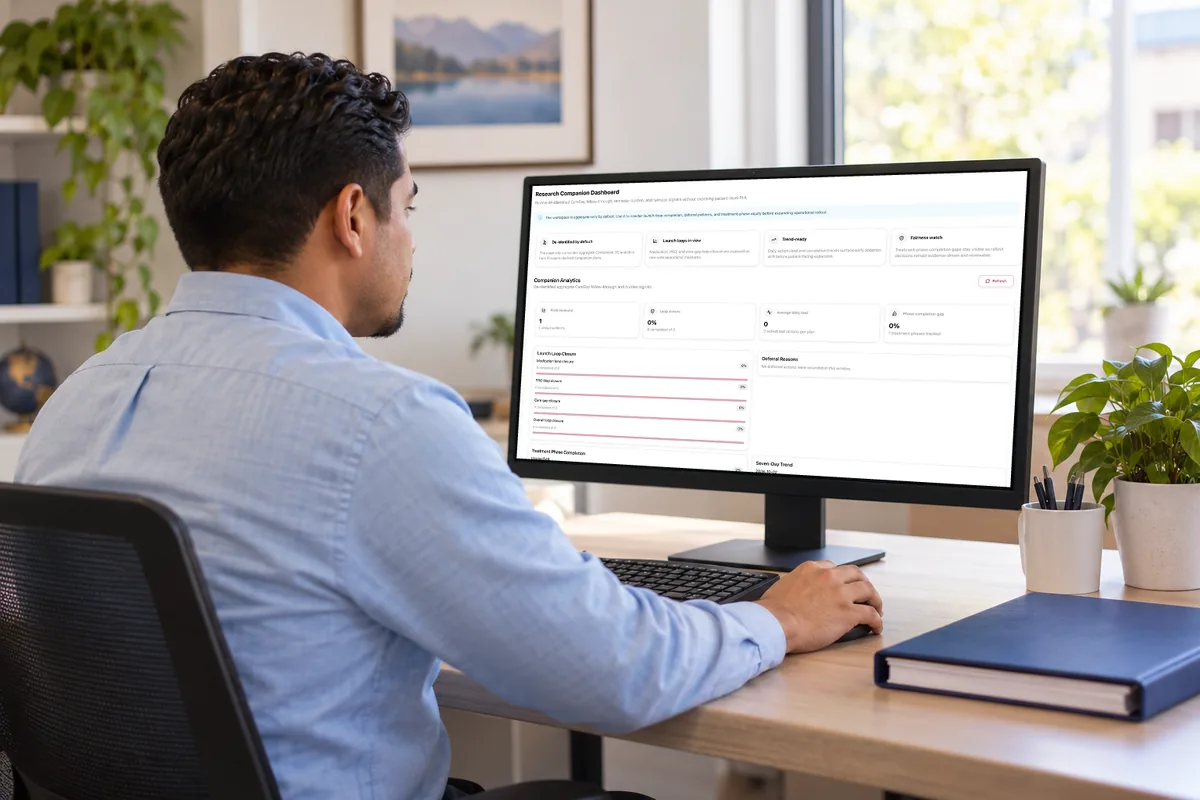
A research collaboration
For clinical research teams that need patient-reported data between appointments.
- We review the protocol with you and agree on the measures, how often patients complete them and which data leaves the app.
- A study starts only after approval from an institutional review board (IRB).
- Research participation requires its own consent, separate from consent to use the app, and is always optional.
- Study data is designed to leave the app de-identified. The research view shows aggregate figures by default.
Consent first
Patients choose what to share and with whom
The app first asks each patient to read and accept the terms of service, privacy policy and health data sharing. Each has its own switch and Read button.
Health data sharing covers the patient’s care team. Patients can also add family members or caregivers and choose one as their primary contact.
Research is a separate choice. Taking part in a study requires its own consent and is optional.
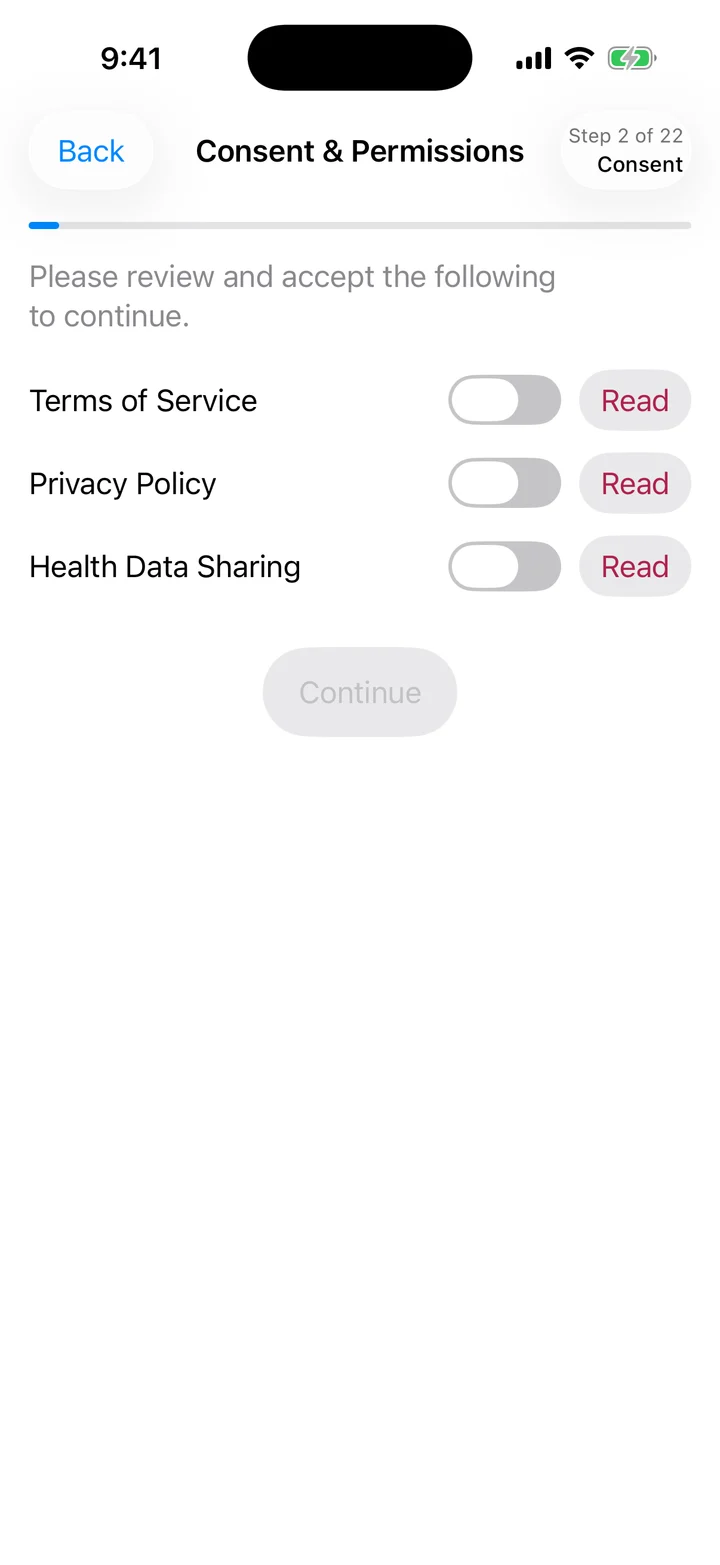
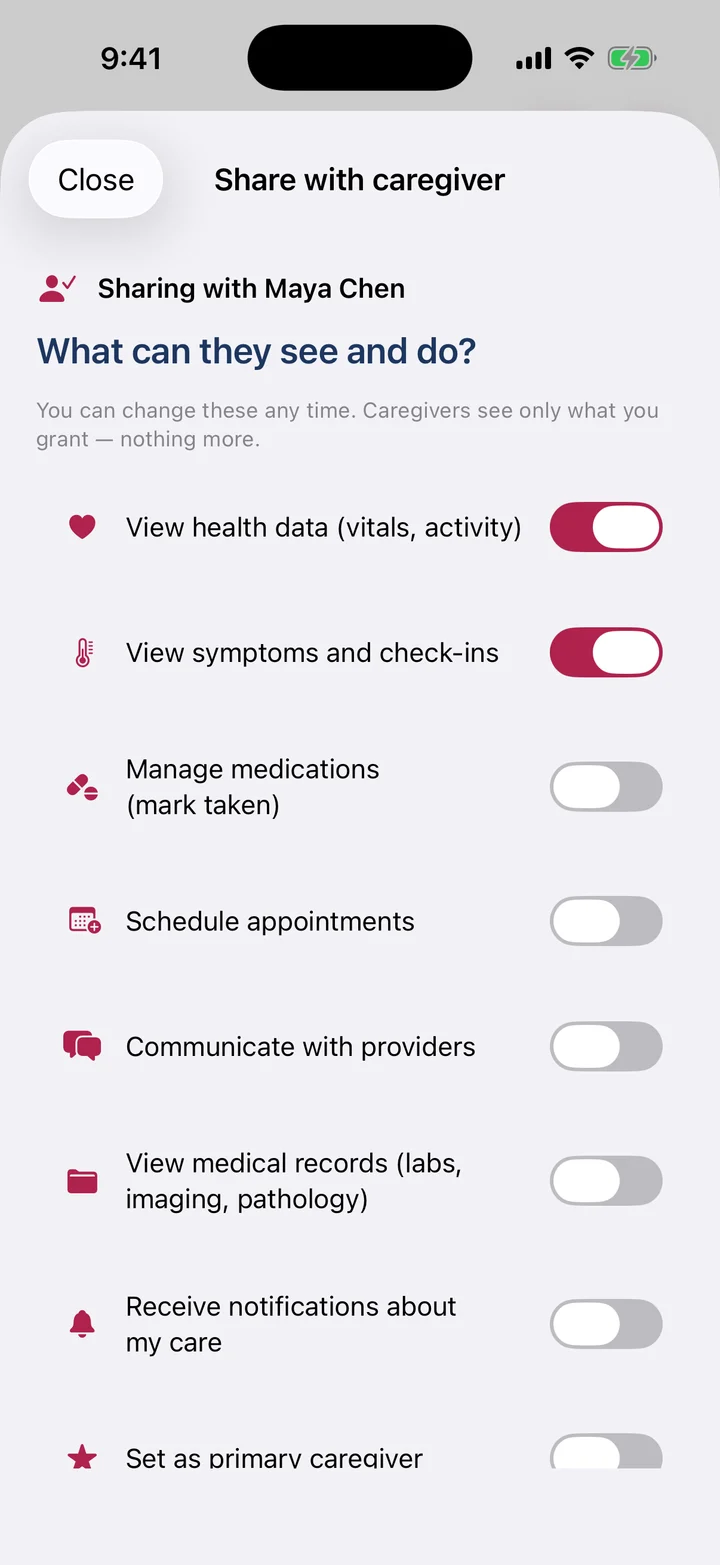
Screens from the app in development. Sample data.
Standards
Built on the standards oncology already uses
FHIR R4
MyBC is being built on FHIR R4. Its server code defines the resources needed by a clinic and a study: Patient, Observation, MedicationStatement, CarePlan, ResearchStudy and ResearchSubject. The record link is built to read and write Patient, Observation, MedicationRequest, Condition and Encounter, with United States Core Data for Interoperability (USCDI) version 3 coverage. Clinical Decision Support (CDS) Hooks are built for the patient-view, medication-prescribe and order-select points. Care-gap detection cites the National Comprehensive Cancer Network (NCCN) or Healthcare Effectiveness Data and Information Set (HEDIS) guideline that defines the gap. Terminologies: SNOMED CT, ICD-10-CM, LOINC and RxNorm.
Links to clinical record systems
A link to a site's medical record system is being built on SMART (Substitutable Medical Applications, Reusable Technologies) on FHIR. Each site registers the link.
Validated instruments
The questionnaires use published instruments with their standard wording and scoring. Instruments that require permission or terms of use stay switched off until the agreement is in place.
| Instrument | Status in MyBC |
|---|---|
| PHQ-9 (Patient Health Questionnaire-9), depression | In the current build as a Logical Observation Identifiers Names and Codes (LOINC) coded FHIR questionnaire |
| GAD-7 (Generalized Anxiety Disorder-7), anxiety | In the current build as a LOINC-coded FHIR questionnaire |
| ESAS-r (Edmonton Symptom Assessment System, revised), symptom burden | Being built in, with release to follow once its terms are confirmed |
| PRO-CTCAE (Patient-Reported Outcomes version of the Common Terminology Criteria for Adverse Events) | Being built in, switched off until its terms of use are agreed |
| FACT-B (Functional Assessment of Cancer Therapy, Breast), quality of life | Being built in, switched off until its terms are agreed |