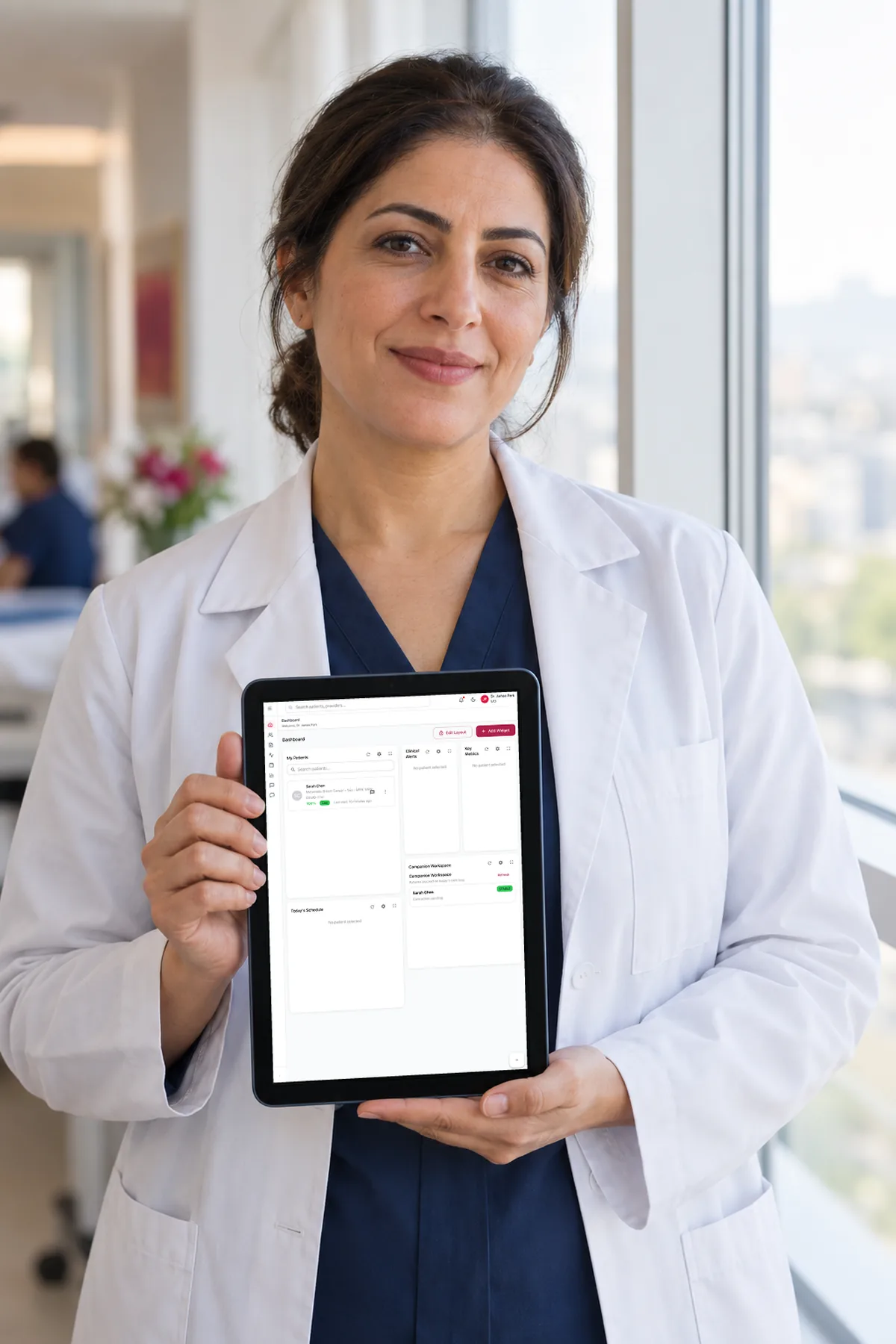
MyBC Health for life sciences
Patient-reported breast cancer data between appointments
MyBC is being designed to record the symptoms and medicines that patients report. It is being built to store them in Fast Healthcare Interoperability Resources (FHIR) R4 format.
MyBC records what happens between appointments. Patients log symptoms, doses and questionnaires at home and choose who can see them: their care team, a caregiver or a study they have consented to.
The problem
Most breast cancer treatment happens between appointments
People receiving endocrine therapy, chemotherapy or radiotherapy spend most of their treatment at home. Their care team learns what happened through what they remember at the next appointment. A study receives that information through a questionnaire completed at the clinic.
Remembering at the visit
A clinic visit relies on what a patient remembers from the weeks since their last appointment. Small changes are easy to forget or downplay.
Side effects at home
Fatigue, neuropathy, hot flashes and nausea can show up on an ordinary day, when no one is asking about them.
Medicines taken at home
Oral endocrine therapy, such as tamoxifen or letrozole, is taken every day for five years or more, with no record of each dose.

What MyBC captures
Patient reports captured as data
Every item in this section is in the current build of the app. Every screen shown is a capture of that build.
Screens from the app in development. Sample data.
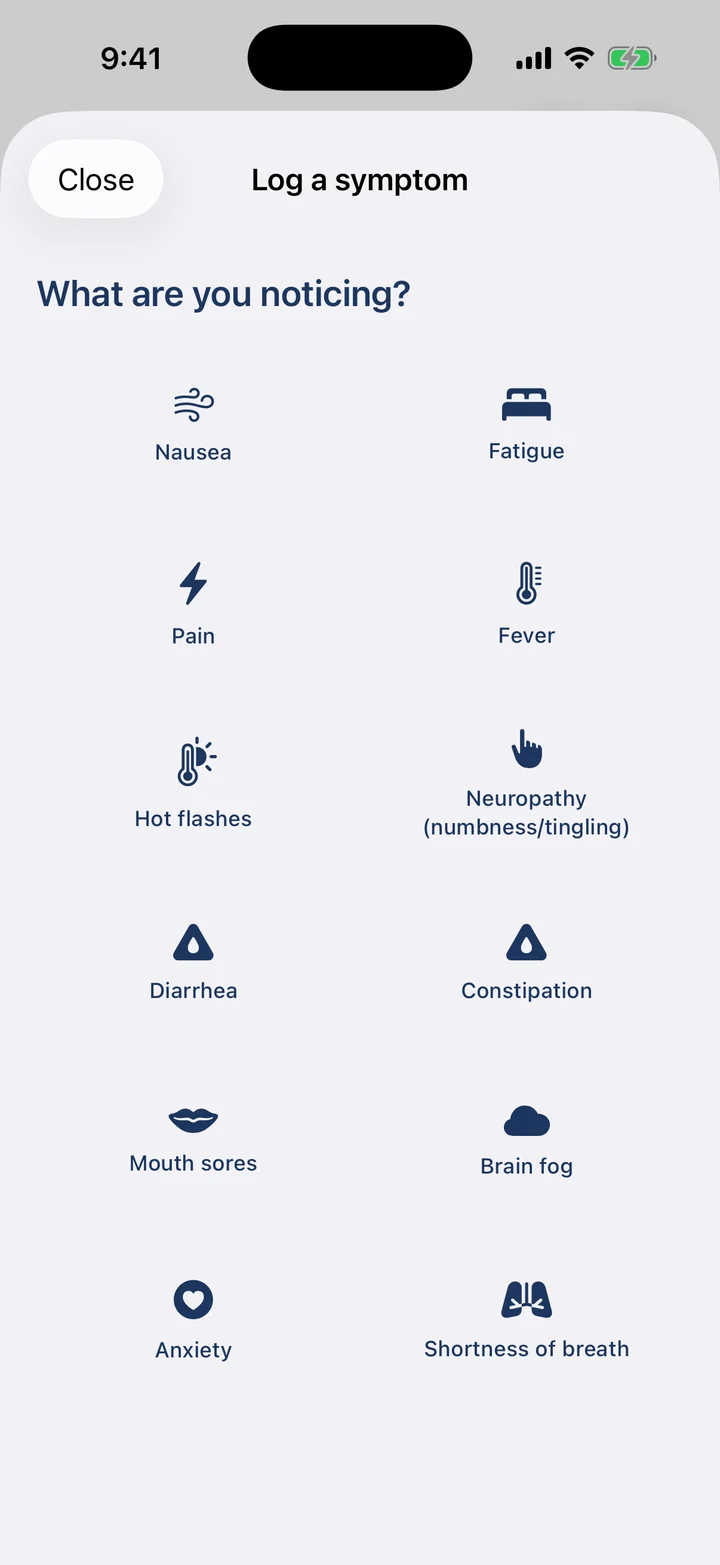
Symptoms as they happen
Patients choose a symptom to log from twelve symptoms common during treatment, including fatigue, pain, neuropathy, hot flashes, brain fog and more.
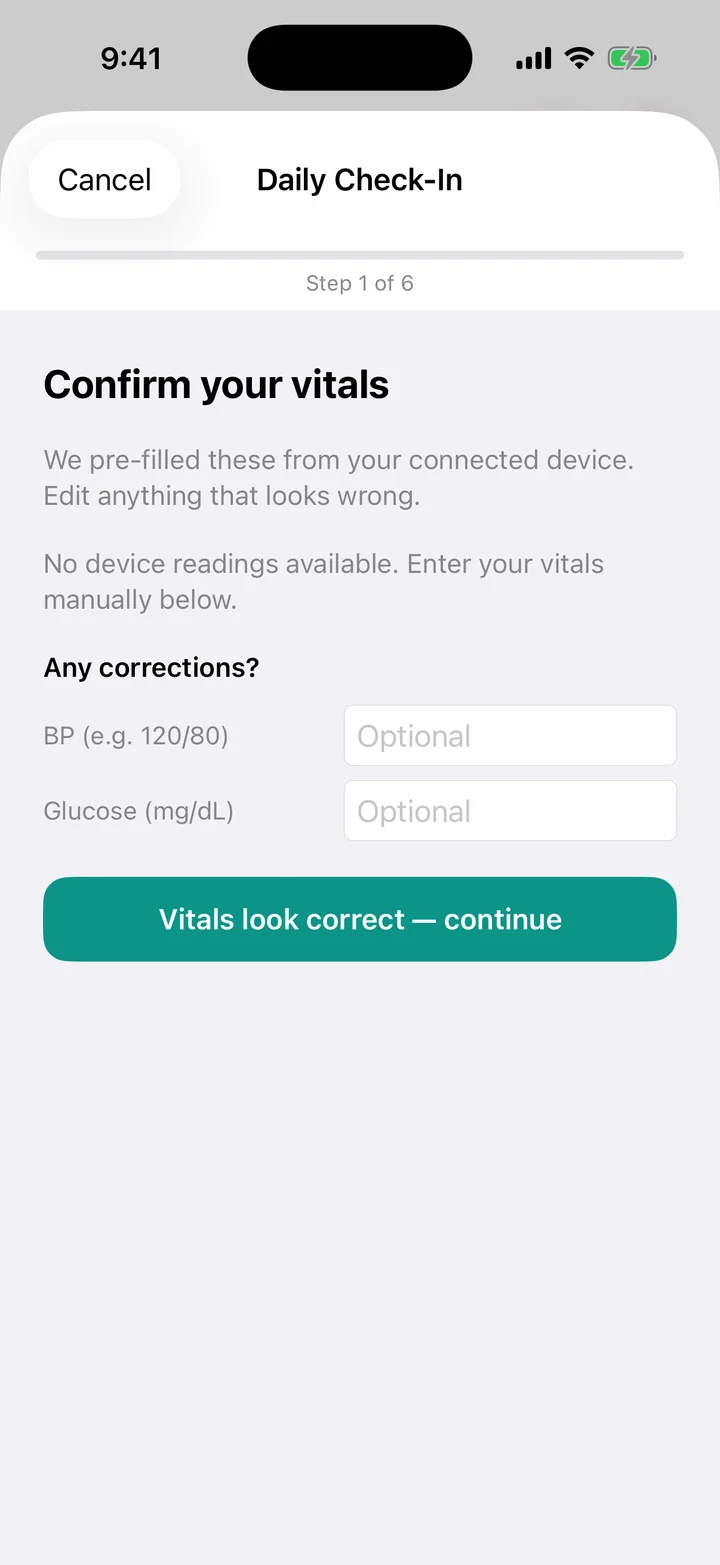
A daily check-in
A short, six-step check-in starts with vitals. The patient confirms readings from a connected device or enters them by hand.
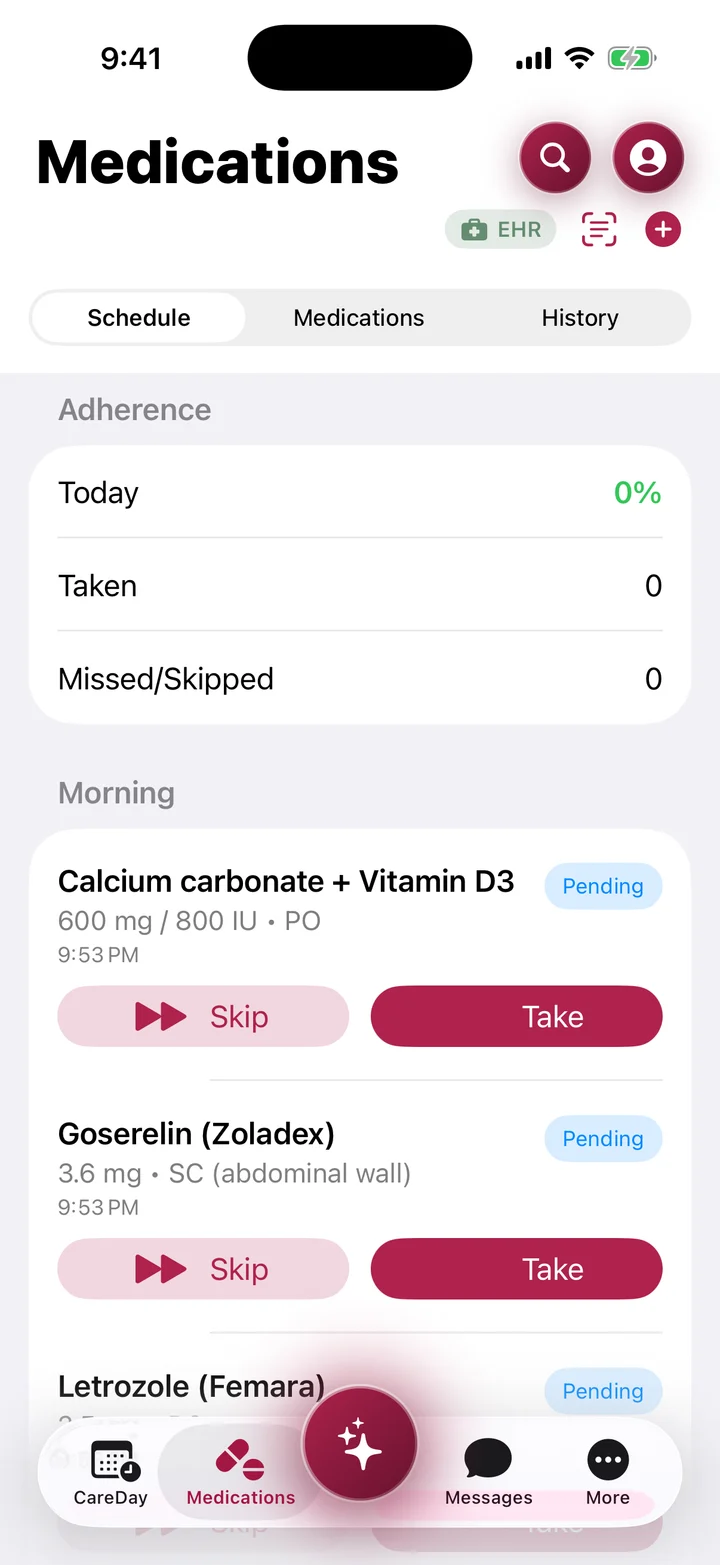
Each dose recorded
Each medicine has a morning and evening schedule with Take and Skip options. Every dose is recorded as taken, skipped or missed.
Mood and anxiety questionnaires
The Patient Health Questionnaire-9 (PHQ-9) and the Generalized Anxiety Disorder-7 (GAD-7) scale use their published wording. Answers appear alongside the symptom log and dose record.
Large text, Spanish next
Screens use the phone’s text size setting. A Spanish version is being built alongside English; some screens are not yet translated.
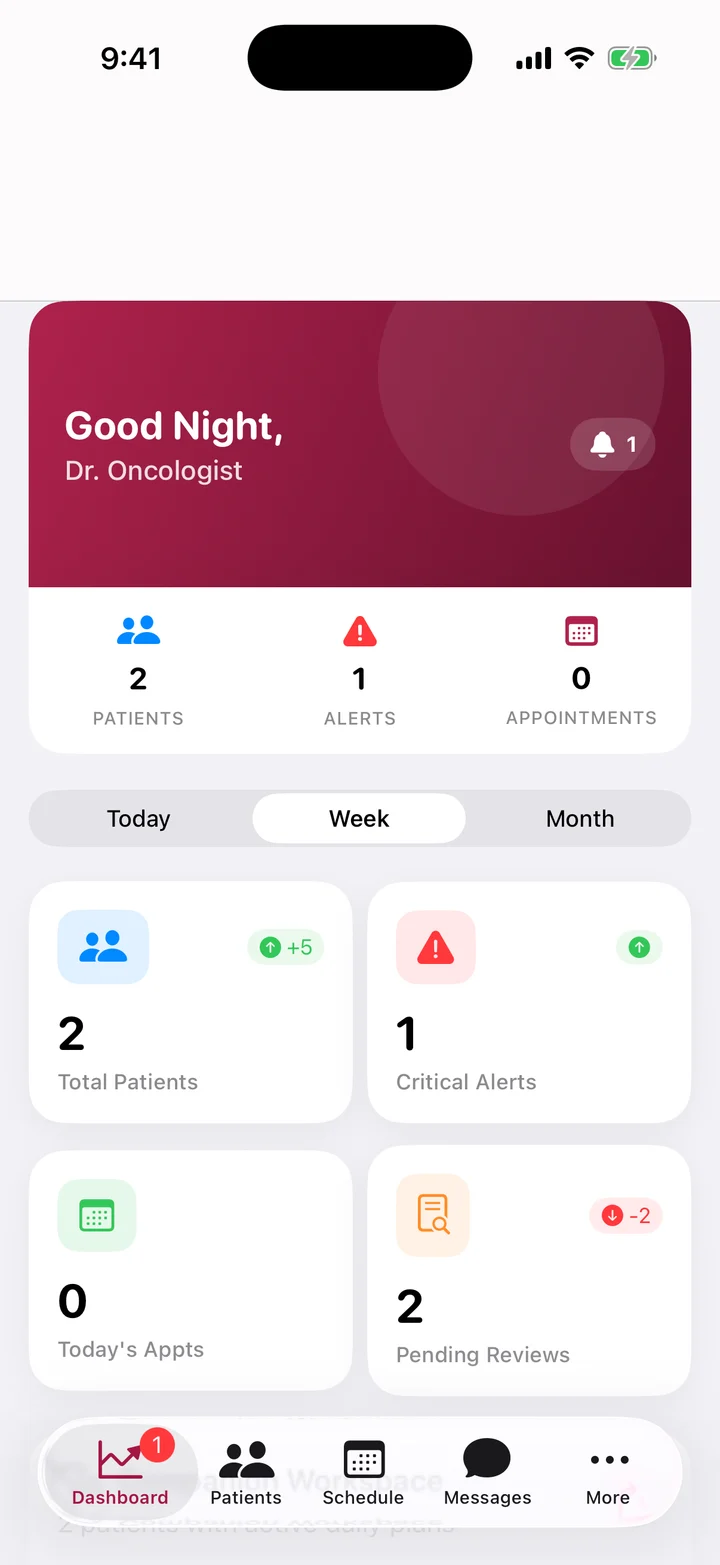
A care team view
A clinician app for iOS and Android and a web portal let care teams see their patients, patient reports and the week’s appointments.
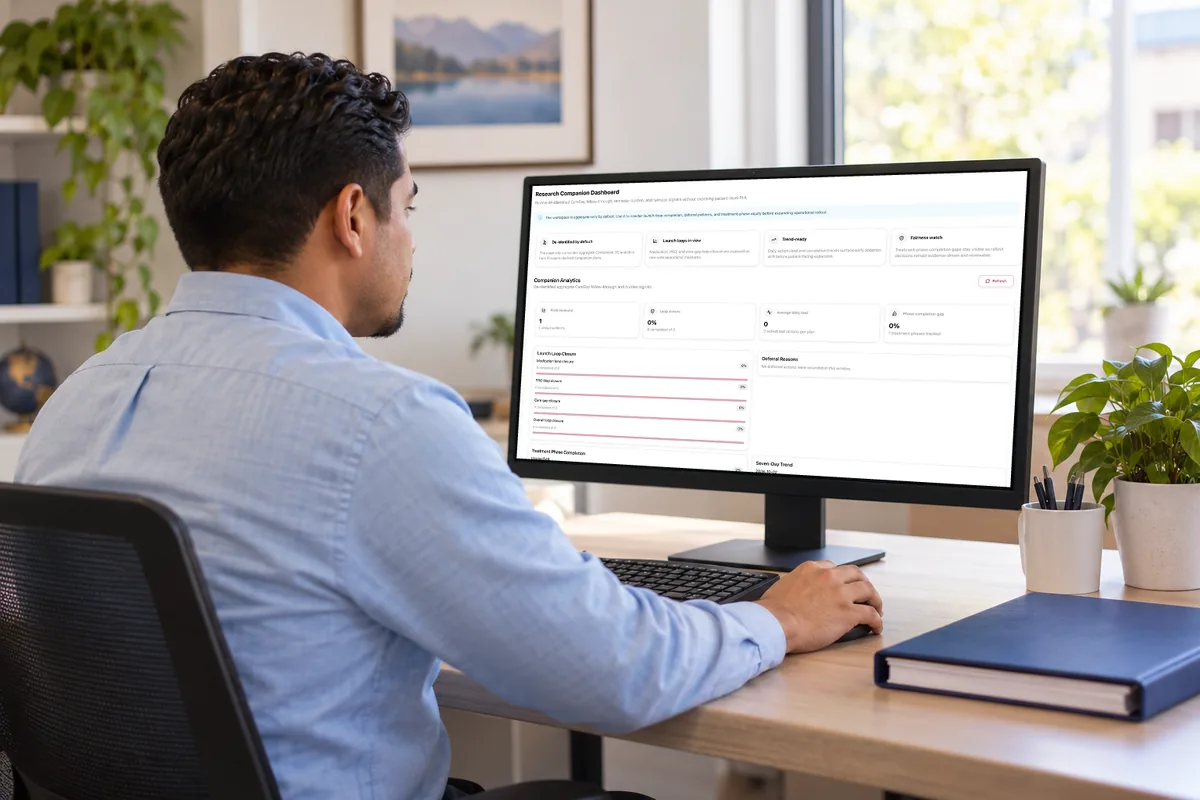
Research view: de-identified by default
The research view uses aggregate figures and shows no patient-level data by default.
Working with MyBC
Two ways to work with us
Both begin with a conversation about your patients and what you need to learn. We agree on the scope in writing before any other work begins.
A pilot or clinical-site partnership
For oncology practices and cancer centers that want their patients to use MyBC.
- We agree on which patients take part, which features they use and who at your site reviews what they share.
- Your institution’s approvals come first, including any review required by your ethics board.
- We set up the app and clinician view with your team and train the staff who will use them.
- A link to your electronic medical record system is planned with your IT team. No such link is live today.
A research collaboration
For clinical research teams that need patient-reported data between appointments.
- We review the protocol with you and agree on the measures, how often patients complete them and which data leaves the app.
- A study starts only after approval from an institutional review board (IRB).
- Research participation requires its own consent, separate from consent to use the app, and is always optional.
- Study data is designed to leave the app de-identified. The research view shows aggregate figures by default.
Who we work with
People who treat, study and support breast cancer
Oncology practices and cancer centers
Hear from patients between appointments through structured reports your team can read before the next appointment, alongside your existing clinical contact.
Clinical research teams
Collect symptom reports, PHQ-9 and GAD-7 answers and dose records from home under a protocol your IRB approves.
Patient-advocacy groups
Help us test the wording, consent screens and Spanish version with the people you represent before patients rely on them.
Sponsors
If you fund or run breast cancer studies, talk with us about collecting patient-reported data between appointments under a protocol you approve.

Consent first
Patients choose what to share and with whom
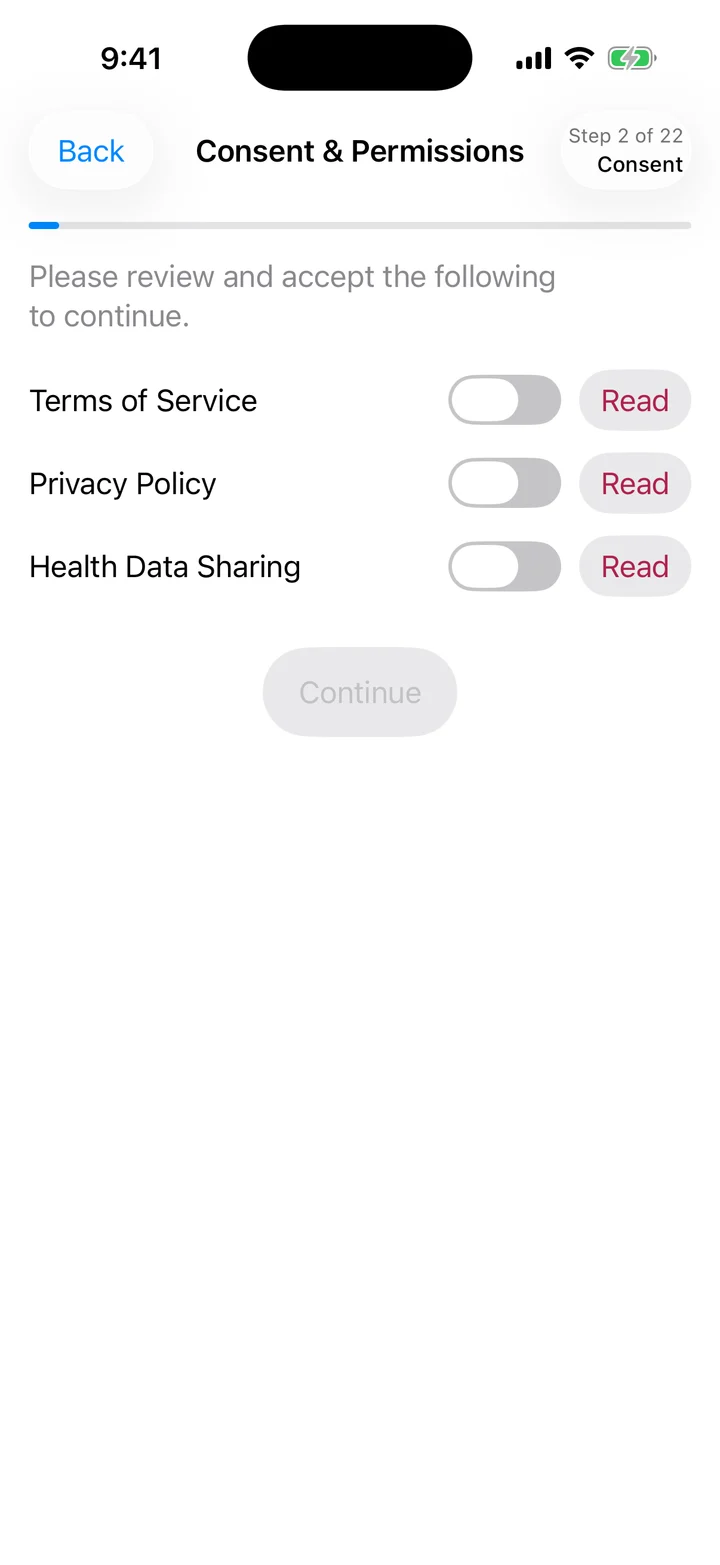
The app first asks each patient to read and accept the terms of service, privacy policy and health data sharing. Each has its own switch and Read button.
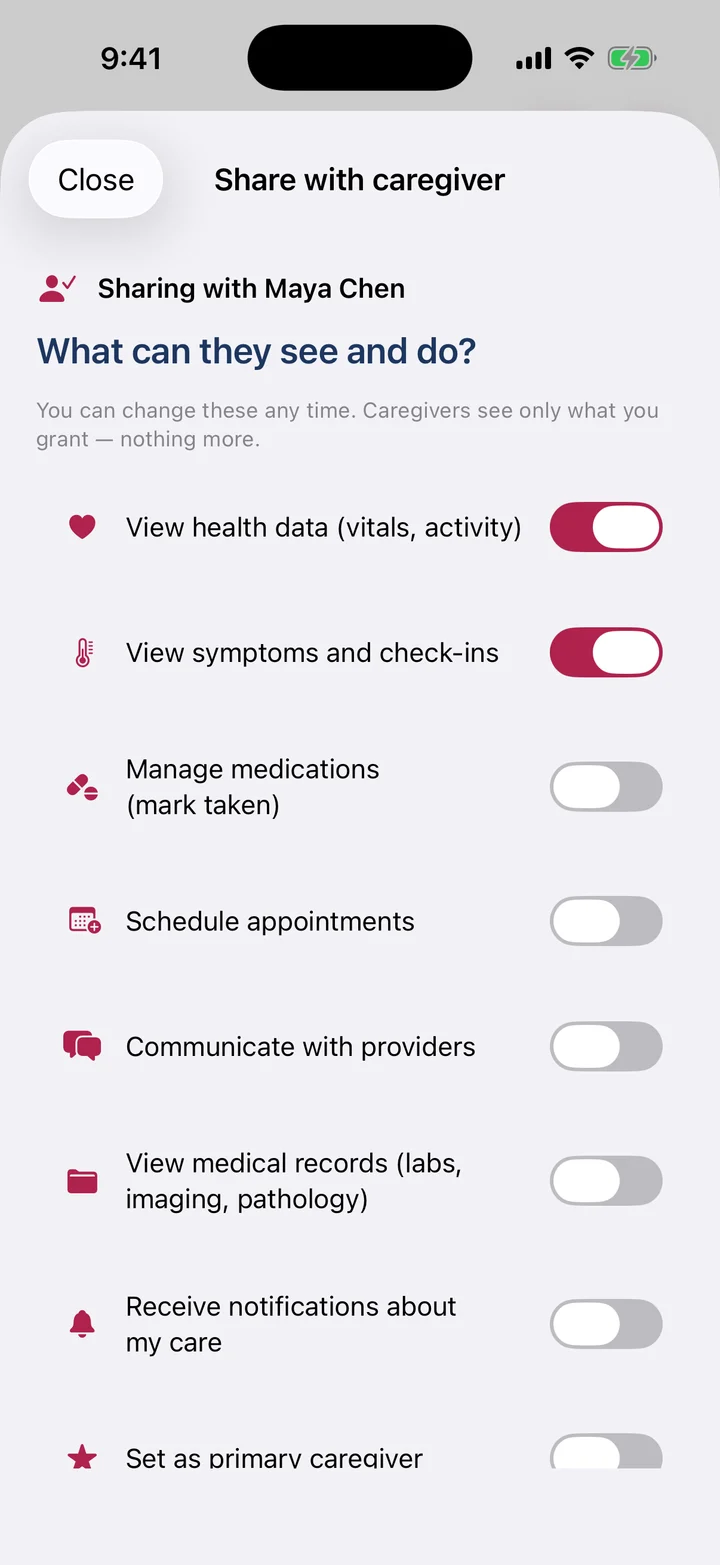
Health data sharing covers the patient’s care team. Patients can also add family members or caregivers and choose one as their primary contact.
Research is a separate choice. Taking part in a study requires its own consent and is optional.
Standards
Built on the standards oncology already uses
FHIR R4
MyBC is being built on FHIR R4. Its server code defines the resources needed by a clinic and a study: Patient, Observation, MedicationStatement, CarePlan, ResearchStudy and ResearchSubject. The record link is built to read and write Patient, Observation, MedicationRequest, Condition and Encounter, with United States Core Data for Interoperability (USCDI) version 3 coverage. Clinical Decision Support (CDS) Hooks are built for the patient-view, medication-prescribe and order-select points. Care-gap detection cites the National Comprehensive Cancer Network (NCCN) or Healthcare Effectiveness Data and Information Set (HEDIS) guideline that defines the gap. Terminologies: SNOMED CT, ICD-10-CM, LOINC and RxNorm.
Links to clinical record systems
A link to a site's medical record system is being built on SMART (Substitutable Medical Applications, Reusable Technologies) on FHIR. Each site registers the link.
Validated instruments
The questionnaires use published instruments with their standard wording and scoring. Instruments that require permission or terms of use stay switched off until the agreement is in place.
| Instrument | Status in MyBC |
|---|---|
| PHQ-9 (Patient Health Questionnaire-9), depression | In the current build as a Logical Observation Identifiers Names and Codes (LOINC) coded FHIR questionnaire |
| GAD-7 (Generalized Anxiety Disorder-7), anxiety | In the current build as a LOINC-coded FHIR questionnaire |
| ESAS-r (Edmonton Symptom Assessment System, revised), symptom burden | Being built in, with release to follow once its terms are confirmed |
| PRO-CTCAE (Patient-Reported Outcomes version of the Common Terminology Criteria for Adverse Events) | Being built in, switched off until its terms of use are agreed |
| FACT-B (Functional Assessment of Cancer Therapy, Breast), quality of life | Being built in, switched off until its terms are agreed |
Clear limits, by design
MyBC does not replace your doctor or your care team.
MyBC will not diagnose, prescribe or tell you to change a dose.
MyBC is not a substitute for professional medical advice, diagnosis or treatment.
We do not sell your information.
Questions
Partner questions
- What stage is MyBC at?
- It is being built. The patient app runs on iOS, Android and the web, alongside a clinician app, a clinician web portal and a research view. Every screen on this site is a capture of those builds.
- Who is it for?
- People receiving treatment for breast cancer, their care teams and research teams that need patient reports from the weeks between appointments.
- Where does the data go?
- Patient data is stored in the app's cloud service on Google Cloud. Patients choose who can see it: their care team, caregivers they add and a study only with separate consent. Patient data is not sold.
- What does a partnership involve?
- We start with a call, then work with you to put the scope in writing: which patients take part, which features they use and who reviews what they share. Your institution’s approvals, setup and training follow.
- How is performance status estimated?
- W-BCOG is the wearable-derived estimate of Eastern Cooperative Oncology Group (ECOG) performance status. MyBC's servers compute it using a 14-day rolling window of six inputs: steps, non-sedentary hours, the FACIT-Fatigue score, sleep efficiency, resting heart rate and the patient's own rating. It uses fixed rules rather than a learned model and shows no score below a 60% data-completeness floor. It is investigational and has not been cleared by any regulator.
- How is the assistant kept within its limits?
- Three layers are planned between a question and an answer. An intent router is being built to remove the 18 Safe Harbor identifiers before any model call. NVIDIA NeMo Guardrails is being added to detect hallucinations and defend against topical drift and prompt injection. An output guard already screens responses for language about prescribing, diagnosing and medication changes, and directs those questions to the care team. Identifiable health data is not used to train general-purpose models.
- How do we start?
- Write to us from the contact page and tell us what you have in mind. Go to the contact page